If you want to know what to expect when selling your app, the honest answer is: it takes longer than you think and pays more than most estimates suggest. A founder recently told us she thought it would take two weeks. She had clean books and a buyer in mind. It took four months.
What to expect when selling your app depends heavily on how prepared you are and who you are selling to. This is the timeline and process that most off-market mobile app deals actually follow. For the bigger picture, our guide on how to sell your app covers the strategy, and you can start when you are ready to sell your app.
Stage 1: Preparation (2 to 4 Weeks)
Before any buyer conversation starts, you need your house in order. This is the stage most founders skip, and it is the one that causes the most problems later.
What preparation looks like: 24 months of clean monthly revenue data, MAU and DAU trends over the same period, Day-30 and Day-90 retention rates, marketing expenses broken down by channel, a clear SDE (seller’s discretionary earnings) calculation, documentation of your tech stack, app store account history, and a list of any third-party services the app depends on.
If your books are messy or your revenue attribution is unclear, fix it before you start talking to buyers. Every inconsistency they find during due diligence costs you negotiating power, and sometimes the deal itself.
Stage 2: Finding Buyers and Initial Conversations (2 to 4 Weeks)
Once your materials are ready, the process moves to buyer outreach. In an off-market deal, this means approaching a targeted list of qualified buyers and not posting publicly.
Initial conversations are high-level. A buyer will want to understand the revenue model, MAU size, the user base, retention rates, and why you are selling. They are not asking technical questions yet. They are deciding whether the opportunity fits what they are looking for.
Expect to sign NDAs before sharing any details. A serious buyer will respect this. Anyone who pushes back on signing an NDA before getting your financials is not someone you want in your deal.
Stage 3: Letter of Intent (1 to 2 Weeks)
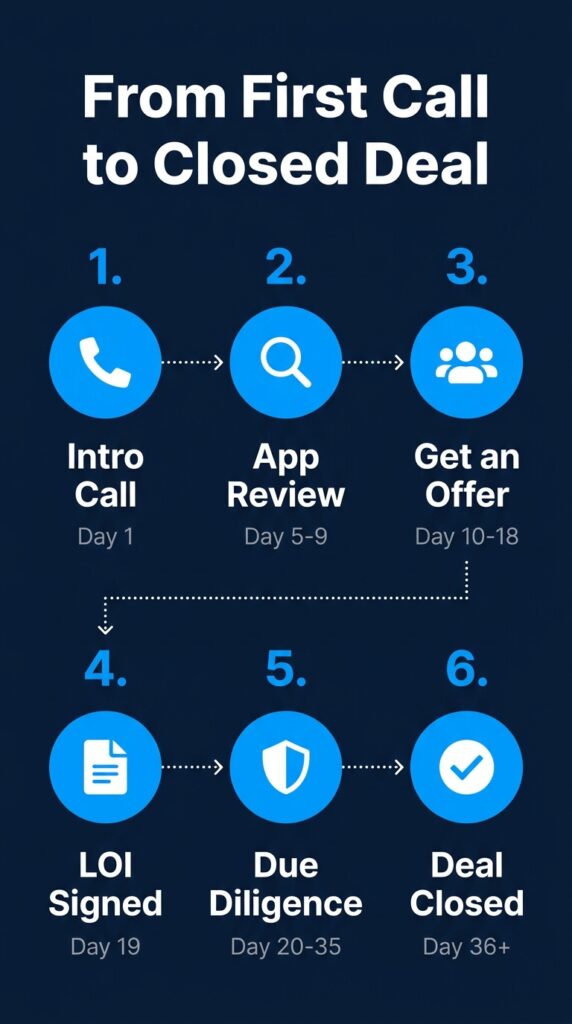
A buyer who is serious after reviewing your financials will issue a letter of intent (LOI). This is a non-binding offer that outlines the proposed deal structure: price, payment terms (cash at close, earnout, seller financing), and any key conditions.
When selling your app, the LOI stage is where valuation is set. The number in an LOI is rarely the final number, but it anchors the negotiation. This is why having competitive tension matters, multiple LOIs give you leverage to push the price up.
Do not sign an LOI with a long exclusivity period unless you are fully confident in the buyer. Exclusivity means you stop talking to everyone else. If that buyer walks, you have lost weeks.
Stage 4: Due Diligence (3 to 6 Weeks)
Due diligence is the most intense part of what to expect when selling your app. The buyer is verifying everything you told them.
They will review your payment processor history, MAU and DAU data, Day-30 retention rates, churn trends, marketing spend by channel, app store connect account, codebase, any contracts or agreements, and often speak with key team members. Financial buyers focus heavily on revenue consistency, churn rate, and profit margins. Strategic buyers dig deeper into the user base, DAU/MAU ratio, tech stack, and integration complexity.
Deals die most often here, not because the app is bad, but because the seller was not prepared. A revenue discrepancy you did not notice, an ownership question you never documented, a dependency you did not disclose, any of these can kill confidence at the worst possible moment.
The best thing you can do is front-load transparency. Share everything relevant early, on your own terms, rather than waiting for a buyer to find it.
Stage 5: Close and Transfer (1 to 2 Weeks)
Once due diligence is complete and both sides are satisfied, you move to closing. This involves signing the purchase agreement, transferring assets (app store accounts, codebase, domain, analytics), and receiving payment.
Most off-market mobile app deals use an escrow service like escrow.com to protect both sides. The buyer deposits funds, the seller transfers assets, and the escrow releases payment once the transfer is confirmed. The whole closing process typically takes 5 to 10 business days.
Expect a transition period after close. Most buyers want 30 to 60 days of seller support, where you are available to answer questions and help them get up to speed. This is usually agreed in the LOI and built into the deal structure.
Common Questions About Selling Your App
How long does it take to sell an app from start to finish? Most off-market deals take 60 to 120 days total. The preparation stage is the one founders consistently underestimate. Getting your financials and documentation ready before you approach anyone will compress the timeline significantly.
What kills most app sale deals? Revenue inconsistencies found in due diligence, sellers who are unprepared to answer technical questions quickly, exclusivity periods given to buyers who are not serious, and founders who set emotional prices disconnected from what the market will actually pay.
Should I use a broker to sell my app? It depends on how much time you have and whether you want the best outcome. A broker handles buyer sourcing, valuation, negotiation, and the full deal process so you can focus on running the business while the sale is in motion. Without one, most founders either undervalue their app, talk to the wrong buyers, or run out of patience halfway through due diligence. If your app is generating above $5k MRR, working with an experienced broker typically pays for itself several times over in the final multiple.
Before You Start
Selling your app is a process, not an event. The founders who come out best started preparing months before they needed to. Clean books, documented operations, and a realistic sense of what buyers are paying right now. That is what sets you up to move fast when the time comes.
Mistakes That Slow Down App Sales
Most deal delays come from the same handful of mistakes. Knowing about them in advance is worth more than any amount of prep done after.
Skipping the preparation stage. The sellers who move fastest through due diligence are the ones who had everything organized before a single buyer conversation started. Clean books, clear SDE, documented operations. Get that in order before you approach anyone.
Talking to only one buyer. Single-buyer processes almost never end at the asking price. Competitive tension is what creates it. Without multiple serious buyers reviewing the same asset, there is no pressure to move on price.
Going in without a floor. If you do not know the minimum you will accept before the first offer arrives, you will make decisions under pressure. Set your number in advance. It keeps you rational when the deal gets tense.
Giving too much exclusivity too early. Agreeing to a long exclusivity window with an unproven buyer is the fastest way to lose months. Cap exclusivity periods and get meaningful proof of funds first.
OEB Digital handles the full process, off-market and confidential. We bring the right buyers to you, manage due diligence, and negotiate on your behalf. You review offers and approve terms.
$20M+ closed across 40+ countries. Serious buyers only. If you want to understand what your exit could look like, start here.