The wire cleared. A $700k app deal, closed at full asking price, done. Most people would call that the finish line.
Then the buyer sent one more message. He wanted an extra feature built into the app before he took over.
That single request turned into an extra $40k for the seller. Not from renegotiating the price. It came from app deal structure, and from one smart decision about who was best placed to do the work.
Here is how it happened, and what it tells you about where the real money in a sale often hides.
The $700k Deal Was Done. Then the Buyer Wanted More
The sale itself was clean. Full asking price, $700k, agreed and signed.
After closing, the buyer decided he wanted a new feature added before he fully took the app over. Nothing unusual. New owners almost always have a list of things they want to change.
The obvious move was to hire an outside developer. Post the job, find a freelancer, hand them the code, and wait.
That is where the problem starts.
Why a Stranger Building Your App Is Expensive
A developer who has never seen the code has to reverse-engineer it before writing a single new line. That takes time, and time is risk.
Senior freelance mobile developers run $125 to $185 an hour, and a full mid-range build can land between $25k and $75k. A feature that should take three weeks can stretch to six when someone is learning the architecture as they go.
There was a better option sitting right there. The seller built the app. He knew every corner of the codebase. He could ship the feature faster than anyone, and ship it right the first time.
Why App Deal Structure Matters More Than the Headline Price
This is the part most founders miss. The number you sell for is not the only number that matters. App deal structure decides how value moves between you and the buyer after the handshake.
Most small app sales already include a transition period. After closing, sellers usually stay on for one to three months to help the buyer get up to speed, and after an initial training window that help is typically paid on an hourly consulting basis.
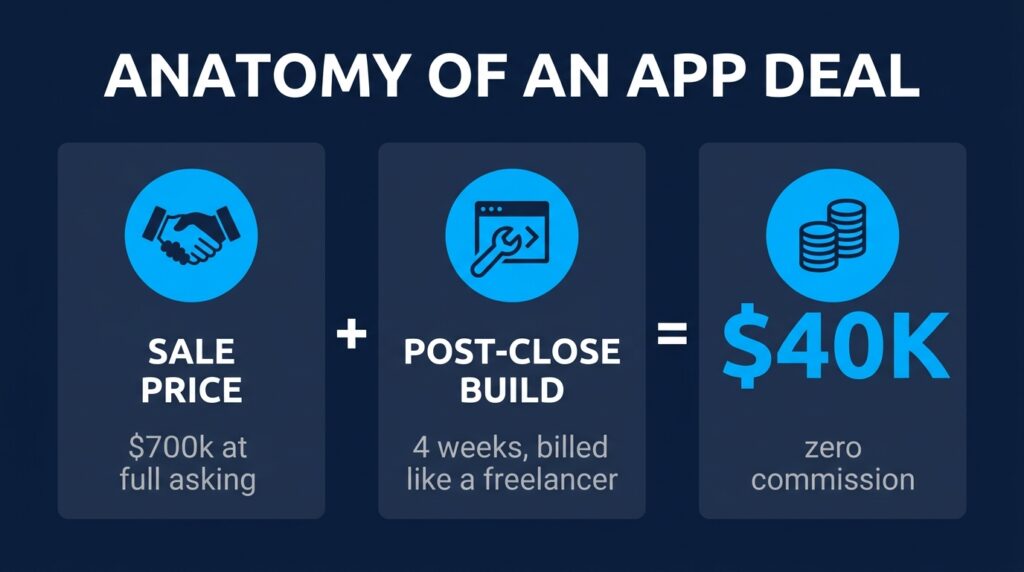
So instead of the buyer hiring a stranger, the seller agreed to build the feature himself, billed like a freelancer. Four weeks of work. An extra $40k, paid on top of the $700k.
The commission on that $40k was zero. It was not part of the sale price. It was the seller earning for his own labor, full stop.
Both sides won. The buyer got the feature built right by the one person who knew the code. The seller got paid well for work he was better positioned to do than anyone else on earth.
The Hidden Value Most Founders Walk Past
Look at how much can change after the price is agreed. Two buyers can offer wildly different terms for the same asset, and the seller who reads the terms walks away with more. We broke that down in our post on why two buyers offered $180k apart for the same app.
The lesson repeats here. The $700k was the asset. The $40k was labor. Treating them as two separate things is what made the extra money possible.
A seller who lumps everything into “the sale” leaves that $40k on the table. A seller who reads the app deal structure gets paid for it.
How to Find Extra Value in Your Own App Deal Structure
You do not need a complicated deal to do this. You need to think past the headline number and treat the app deal structure as its own lever. Here is how.
Do not treat closing as the end. The weeks after a sale are full of small jobs the buyer needs done: a feature, a server migration, documentation, an intro to a key ad partner. Each one has a price.
Know what only you can do. Your edge is the code, the users, the ad accounts, the app store ranking. A buyer pays a premium for that knowledge because the alternative is slower and riskier.
Separate sale price from service price. The asset is one line. Your post-close work is another. Keep them distinct so the deal stays clean and your time is paid fairly.
Put it in writing. A short transition or consulting agreement that spells out scope, hours, and rate protects both sides. For the sale funds themselves, a service like escrow.com keeps everyone honest while the asset changes hands.
Think bigger with earn-outs. When a buyer and seller cannot agree on price, an earn-out ties part of the payment to future performance and bridges the gap. It is the same idea as the $40k feature, scaled up: value that shows up after closing because the deal was built to allow it.
What This Means for Your Exit
A sale is not one number. It is a structure, and a good app deal structure finds value that a bad one leaves on the table.
The seller in this story never asked for the extra $40k. It showed up because the deal was built to let it. That is the difference between selling an app and structuring a real exit.
If you are thinking about your own exit, the headline price is where the conversation starts, not where it ends. A broker who only chases the top-line number is doing half the job. The other half is everything that happens around it.
See how OEB Digital structures off-market app deals, and what your app could be worth when the whole deal is built right.
FAQ
What is app deal structure?
It is how a sale is put together beyond the price: the payment terms, the transition period, any earn-out, and the post-close work. Two deals at the same price can pay out very differently depending on structure.
Can I get paid for work after I sell my app?
Yes. A good app deal structure treats post-close work as its own line, so anything beyond basic handover, like building a new feature, is normally billed on an hourly or project basis on top of the sale price.
How long is the transition period when you sell an app?
For most small app deals it runs one to three months. An initial training window is usually included in the sale, and anything beyond that is paid separately.