Most founders try to sell without a mobile app broker. Here is what usually happens. A founder with a $35k MRR app decided to sell it himself. He found a buyer, agreed on a price, and shook hands on a deal. Three months later, the deal was dead. The buyer walked during due diligence after finding inconsistencies in the revenue data. The founder had not noticed them. A mobile app broker would have caught them in week one.
This is not a rare story. Most founders who sell without a specialized broker either leave significant money on the table or lose the deal entirely. Here is what a mobile app broker actually does, and why the right one pays for itself many times over. If you are getting ready to sell your app, it also helps to understand how to sell your app from start to finish.
What a Mobile App Broker Actually Does
Most people think a broker just connects a buyer and a seller and takes a fee. That is about 10% of the job.
A specialized mobile app broker prepares your financials for buyer scrutiny, organises your MAU and DAU trends, retention rates, marketing expense breakdowns, and SDE into a clean data room, identifies which type of buyer your app appeals to, runs a structured process to create competitive tension, manages due diligence, and holds the deal together when one side gets cold feet. That last part alone saves more deals than most founders realize.
In the mobile app and games space specifically, a good broker also brings a network of pre-qualified buyers who are actively looking to acquire. You are not starting from zero. You are walking into a room of people who already want what you have.
Why Going It Alone Usually Costs More Than the Broker Fee
There are three ways founders lose money when they sell without a mobile app broker.
They price it wrong. Without market data on comparable deals, founders either underprice and leave money behind, or overprice and scare off serious buyers. Either way, the final number suffers.
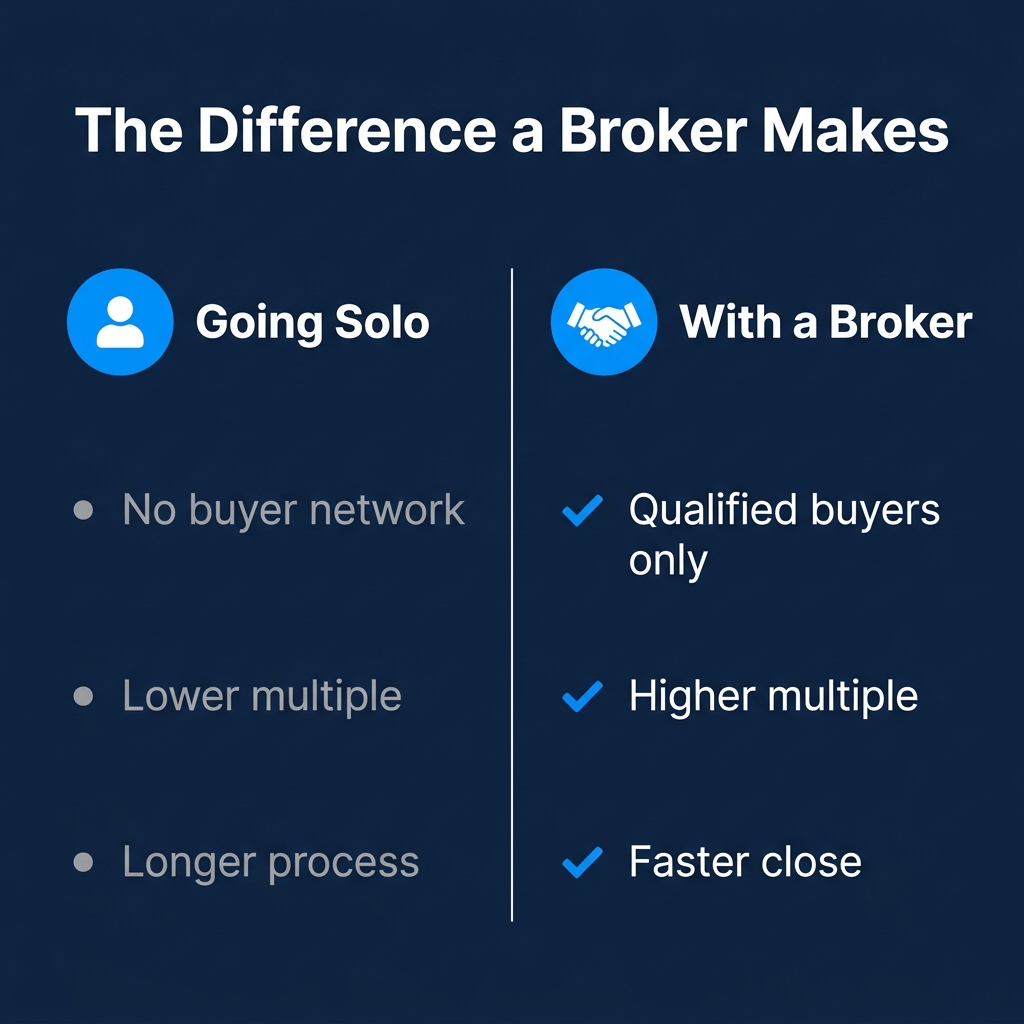
They talk to one buyer at a time. Without competitive tension in the process, buyers know they can take their time and push on price. A broker runs a structured process where multiple buyers are engaged simultaneously. That pressure alone typically adds 10 to 30% to the final offer.
They are not prepared for due diligence. Buyers probe hard. MAU and DAU trends, Day-30 retention rates, marketing spend as a percentage of revenue, churn data, revenue consistency, ownership structure, app store account history, and codebase quality. A broker prepares all of this in advance so nothing surprises the buyer mid-process. Surprise kills deals.
What to Look for in a Mobile App Broker
Not all brokers are equal, and most general business brokers are not equipped to sell mobile apps. The space has its own valuation frameworks, due diligence requirements, and buyer types that a generalist simply does not know.
Look for a broker who has closed real deals in the mobile app or games space, not just listed them. Ask how many deals they have closed in the last 12 months, what the average deal size was, how long deals typically take from start to close, and whether they understand mobile-specific metrics like MAU, DAU, retention cohorts, and marketing efficiency ratios. Good brokers have clear answers to all three.
Also ask whether they work off-market or list publicly. Off-market deals protect your confidentiality with employees, users, and competitors. A broker who posts your app to a public marketplace is working a volume game. A broker who brings it to a curated network of pre-qualified buyers is working your deal.
When Does Using a Broker Make Sense?
If your app generates more than $5k in monthly net profit and you want a clean, fast, off-market exit, a specialized mobile app broker is almost always worth it. The fee is typically a percentage of the final deal value, meaning the broker only wins when you win.
If you already have a direct buyer relationship, a strong network of operators, and experience structuring M&A deals, you might be fine on your own. Most founders do not have all three.
Common Questions About Using a Mobile App Broker
How much does a mobile app broker charge? Most specialized brokers work on a success fee, meaning they get paid when the deal closes. No upfront cost. The fee varies by broker and deal size. Happy to talk through the specifics directly.
Will using a broker slow down the process? The opposite. A broker who has done this before runs a structured timeline. Most off-market deals managed by an experienced broker close in 60 to 90 days. Founder-led deals with a single buyer typically take twice as long, if they close at all.
Can I stay anonymous during the process? Yes. A good mobile app broker uses NDAs before sharing any identifying details, and keeps your name and app identity confidential until serious buyers have qualified. Your employees, users, and competitors do not need to know you are considering an exit.
Mobile App Broker FAQ
Common questions founders ask before deciding whether to use a mobile app broker.
When should I hire a mobile app broker? As soon as you start thinking seriously about an exit. The earlier you bring in a broker, the more time there is to optimize your financials, position your app correctly, and build competitive tension in the buyer process.
How does a mobile app broker get paid? A specialized mobile app broker earns a success fee when the deal closes, paid only at close. No upfront cost. The broker only gets paid when you do.
How long does the broker-led process take? Most off-market deals managed by an experienced mobile app broker close in 60 to 90 days. Founder-led deals with a single buyer typically take two to three times as long, if they close at all.
OEB Digital is a specialized mobile app broker with $20M+ in closed deals across 40+ countries. Off-market, MNDA-first, serious buyers only. Start here.