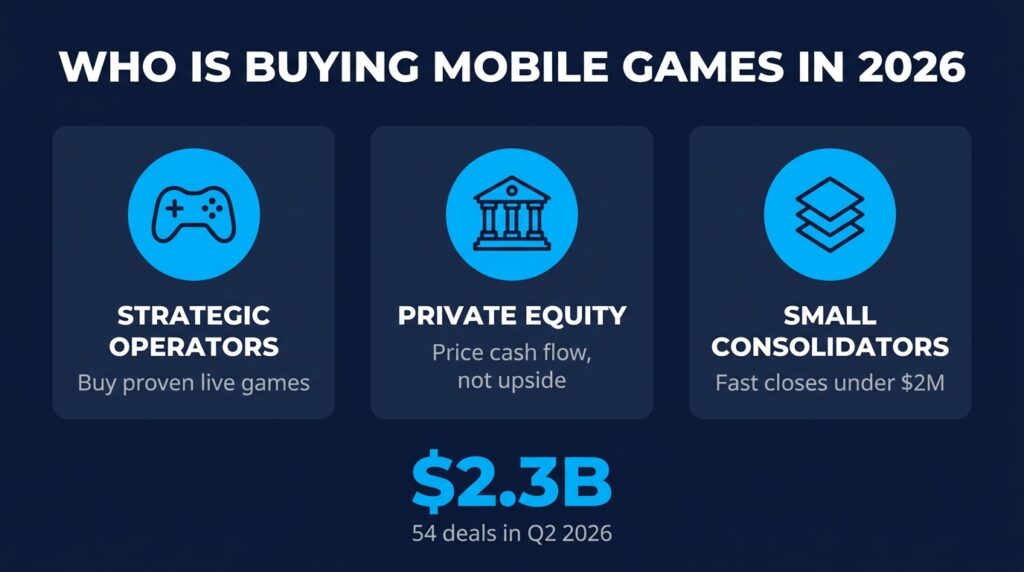
In the second quarter of 2026, the games industry closed 54 acquisitions worth $2.3 billion. In that same quarter, mobile in-app purchase revenue fell 4% year over year and installs hit a multi-year low, down 12%.
Read those two facts together and the mobile game acquisition trends of 2026 stop looking confusing. Buyers are spending more while the market they are buying into gets smaller.
That is not a contradiction. It is a signal about who is buying, what they are paying for, and what they will refuse to pay for. If you own a game or an app and you are thinking about an exit in the next 12 months, this is the market you are selling into.
Mobile Game Acquisition Trends in 2026 Are Set by the Mid-Market
The headline number is $2.3 billion across 54 transactions, according to Aream and Co’s Q2 2026 market update. That trails the first quarter’s $7.7 billion, and founders read that drop as a cooling market.
It is not. Q1 was one deal. Savvy Games Group’s $6 billion purchase of Moonton accounted for most of the quarter by itself.
Strip out the outlier and the picture is stronger than the mobile headlines suggest. Deal activity reached its highest level since 2022. Acquisitions valued above $100 million hit their highest count since the pandemic boom.
That is the part most founders miss. The era of one $12 billion headline per quarter is over. The mid-market era started, and the mid-market is where almost every app and game founder actually sells.
Look at what closed last quarter. Playstack sold to TPG’s imc for $168 million. Nazara took a controlling stake in Bluetile for $201 million. JustPlay went for $289 million. Scopely closed Loom Games at $1 billion. WeMade’s founder agreed to sell a controlling stake to NeoPulse at roughly $591 million.
None of those are the megadeals of 2021. All of them closed.
Who Is Actually Writing the Checks
Three types of buyer drive mobile game acquisition trends right now, and each one prices your asset with completely different math.
Strategic operators buying proven live games. Supercell completed its full acquisition of Metacore, the Merge Mansion studio, in 2026. Metacore’s growth had plateaued and the studio moved to cut up to 160 roles. Supercell bought it anyway, because a stable game with a loyal player base is worth more inside a portfolio that already knows how to run live operations at scale.
Private equity and holding companies. TPG, EQT and Blackstone are all active in games. They price cash flow, not upside. They want clean books, low key-person risk, and a transition plan that does not depend on you staying for two years.
Small consolidators. A wave of app acquisition and publishing companies launched out of studio alumni over the past two years. These are the buyers most likely to look at an asset doing $10k to $200k a month in profit, and they move faster than anyone else on the list.
Which of these three shows up for your deal changes your number more than your revenue does. We broke that down in detail in why two buyers offered $180k apart for the same app. Same product, same metrics, two completely different valuation models.
The Number Nobody Wants to Talk About
Mobile is under real pressure, and that pressure shapes mobile game acquisition trends more than any single headline deal does. Gross in-app purchase revenue was down 4% year over year in Q2 2026, installs were down 12%, and public markets punished the category harder than the private one.
Mobile-first Western publishers were down 13% year to date. Mobile-first Asian publishers were down between 37% and 42%. Large-cap diversified companies gained 24% over the same stretch, per the Drake Star Global Gaming Report for Q2 2026.
Buyers read the same reports you do. When a category stops growing, buyers stop paying for growth stories and start paying for evidence.
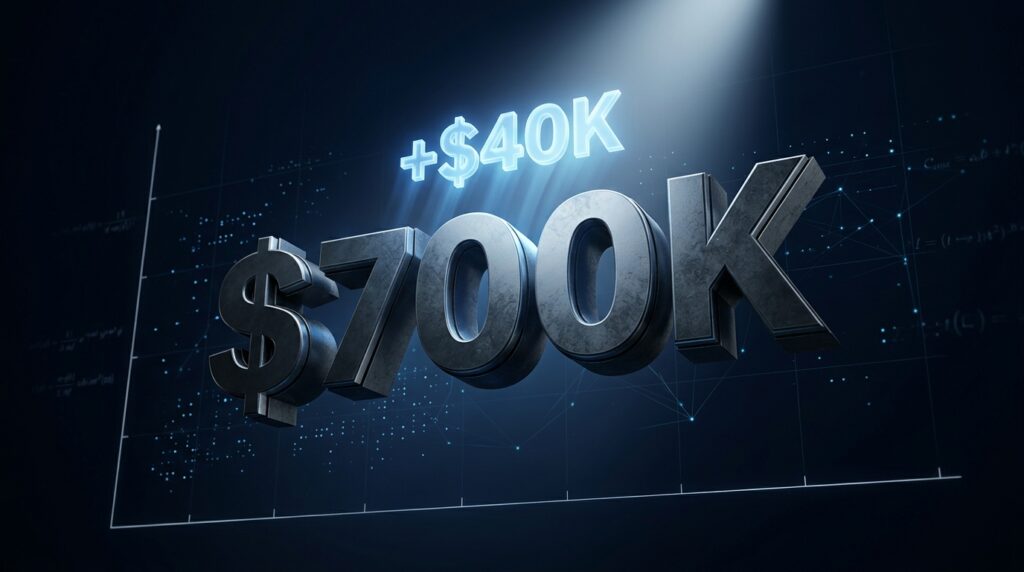
Evidence means retention curves, revenue concentration, and how much of the business runs without you in it. A game with flat revenue and 25% Day-30 retention will beat a game with a hockey-stick chart and 3% Day-30 retention every single time. One founder found that out the hard way and it cost him $750k on a single deal.
What to Do If You Are Selling in the Next 12 Months
Four things move your outcome, no matter which direction mobile game acquisition trends run next.
1. Fix the retention story before you list. Not just the number, the story around it. Show cohort data across 12 months, not a screenshot of last week’s dashboard.
2. Reduce channel concentration. If one ad network drives most of your installs, that is a discount waiting to happen. Organic and ASO-driven revenue prices higher than paid-dependent revenue, because the buyer inherits a machine instead of a bill.
3. Get your documentation ready early. Mid-market buyers with institutional money run real diligence, and that has become the norm as deal sizes climb. Our guide on preparing your app for sale lists what they ask for and when they ask for it.
4. Use escrow. This is not optional at any deal size. Escrow.com is one standard option for transactions in this range.
Common Questions About Selling in This Market
Is 2026 a bad year to sell a mobile game?
No. Mobile game acquisition trends point to a selective year, not a dead one. Deals above $100 million are at their highest count since the pandemic boom while mobile revenue declines, which means capital is concentrating rather than disappearing. Assets that can prove their numbers are getting paid. Assets that cannot are sitting.
Do mobile game acquisition trends apply to small apps too?
Mostly yes, with one difference. Small consolidators and individual operators dominate the sub-$1M range, and they close in weeks rather than months. The diligence is lighter, but the same retention and concentration questions decide the price.
How long does a mid-market app or game deal take?
Mobile game acquisition trends have not changed timelines much. Expect 60 to 120 days from first buyer conversation to wire for most deals in the $200k to $2M range.
Institutional buyers on larger transactions run longer. Preparation before you go to market is what compresses that timeline.
The Takeaway
The mobile game acquisition trends of 2026 are not a story about a dying market. They are a story about a market that stopped rewarding hype and started rewarding proof.
Fifty-four deals closed last quarter, and that is the clearest read on mobile game acquisition trends you will get.
Someone paid $168 million for a publisher and someone paid $1 billion for a studio in a category where installs are falling. That money went to assets with defensible retention, diversified revenue, and books a buyer could verify in a week.
If your app or game can prove its numbers, this is a good year to test the market. If it cannot yet, you have 6 to 12 months of work ahead of you, and doing that work is worth more than any negotiation tactic.
Not sure which one you are? Get an honest, data-backed read on what your app is worth before you decide.