In This Article
Mobile app retention metrics are the number that can cut a deal price in half. His app was doing $30,000 a month. Three months earlier, it had been doing $8,000. Growth was vertical, the product was hot, and the number $1M had come up in our first conversation. A 3x multiple on the trailing 12 months. He was already spending it.
Then we pulled the mobile app retention metrics.
What the Dashboard Was Hiding
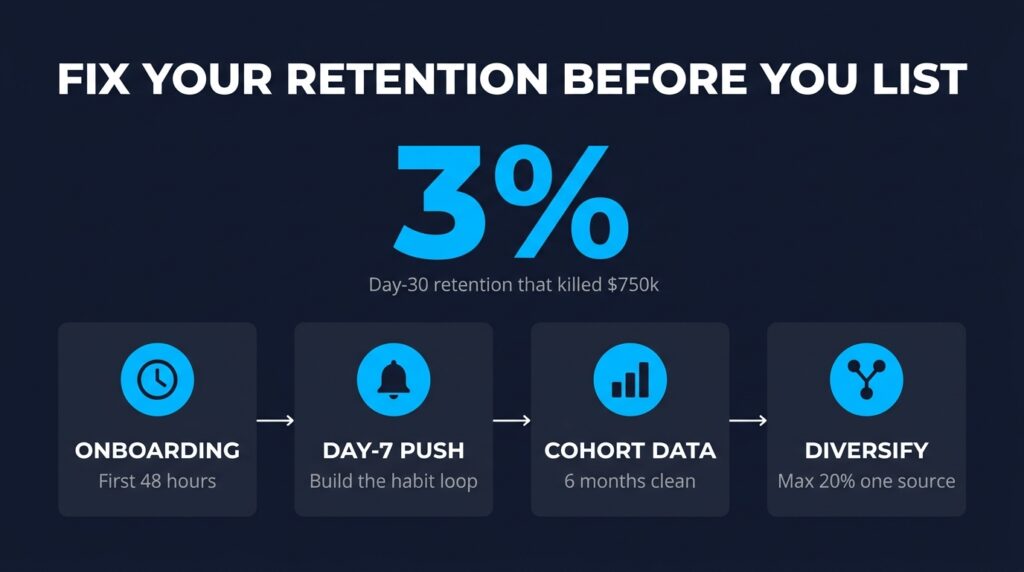
The growth was real. But so was the problem underneath it. The app had gone viral through a specific Reddit thread, and 60% of new users had arrived in a three-week window. Day-30 retention was sitting at around 3%. Industry averages for mobile apps hover between 5 and 7%. For subscription-based apps, buyers expect to see 12% or higher.
This wasn’t a growing business. It was a spike with a very predictable cliff.
When a buyer’s due diligence team looks at your app, MRR is the starting point, not the conclusion. The real scrutiny comes when they open your cohort data. How many users from six months ago are still paying today? What does your Day-1, Day-7, and Day-30 retention look like across acquisition channels? If your biggest traffic source disappeared tomorrow, what does revenue look like in 90 days?
This founder’s answers weren’t good.
The Numbers Buyers Actually Use
Buyers evaluating mobile apps for sale build a model. That model starts with retention.
If your Day-30 retention is 5%, a buyer assumes that for every 100 users you acquire, 5 will still be there in a month. They multiply that by average revenue per user, then by acquisition volume, and that tells them what the business generates in steady state.
Viral spikes break the model. A one-time traffic event inflates MRR in a way that doesn’t repeat. When buyers see a steep growth curve alongside a 3% Day-30 retention rate, they don’t see upside. They see risk they’d be buying at the peak of.
The founder didn’t believe it. “The users are there,” he said. “The revenue is there.” It was, right up until it wasn’t.
The Cliff
Three months after our first conversation, MRR had dropped from $30,000 to $8,000. The Reddit thread dried up. The burst of users stopped opening the app. Subscriptions lapsed. There was no retained base to hold the floor.
The $1M conversation became $250,000.
That $750,000 didn’t evaporate because the market shifted. It disappeared because the mobile app retention metrics buyers use to price acquisitions were never there to support the valuation. No buyer will pay a premium multiple for revenue built on a single traffic event. When MRR normalizes, so does the multiple, and both hit at the same time.
How to Fix Your Retention Before You List
If you’re planning to exit in the next 12 to 24 months, your mobile app retention metrics for sale preparation should start today. Not your download count. Not your next revenue push. The percentage of users who come back.
Onboarding first. Most apps lose 60 to 70% of users in the first 48 hours. This is almost always an onboarding problem. A user who doesn’t see value before they close the app the first time won’t open it again. Shorten the path from install to that first moment of value.
Day-7 engagement. Push notifications, in-app prompts, and email follow-ups sent on Day-2, Day-5, and Day-7 have a measurable impact on 30-day retention. The goal is to build a habit loop before the user forgets the app exists.
6 months of clean cohort data. Buyers will ask for it. If you can show that the cohort from January still has 15% retention in June, that is a very different story than a single MRR screenshot. Give yourself enough runway to build that record before you go to market.
Channel diversification. If more than 20% of your revenue comes from one traffic source, buyers will discount the business. Build organic, referral, or paid channels with predictable returns.
What Mobile App Retention Metrics Mean for Your Exit
Mobile app retention metrics for sale conversations are where most founders get surprised. The number they have been watching is MRR. The number a buyer is watching is cohort retention six months out.
A business generating $15k MRR with 18% Day-30 retention is often worth more than one with $30k MRR and 3%, because the buyer’s model tells them where the $15k is in six months. The $30k is anybody’s guess.
The founder in this story had a solid product. The core of the app worked. But by the time retention had stabilized and a new revenue baseline was established, 12 months had passed and the market had moved.
Don’t wait for a viral spike to sell. Don’t try to sell during one. Sell when you have 6 to 12 months of clean, improving retention data, and buyers can model the future themselves.
OEB Digital has closed $20M+ in mobile app and game deals across 40+ countries. If you want to understand what buyers will see when they look under the hood of your business, start the conversation at oebdigital.com/sell-my-app/.