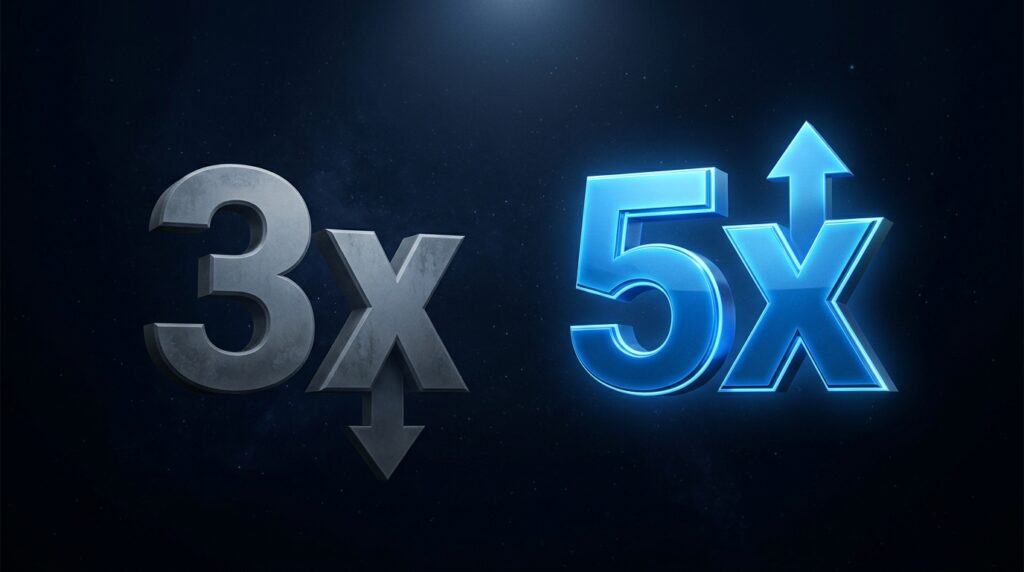
Two buyers looked at the exact same app and came back with a wildly different app valuation multiple. Same $28k MRR. Same retention. One offered $180k more than the other. The gap had nothing to do with the numbers.
This is about selling an app you already own, not building one. If you run a live app with real revenue and an exit is on your mind, the app valuation multiple a buyer applies to your profit is where six figures are won or lost.
What Each Buyer Was Actually Buying
The gap between those two offers had nothing to do with negotiation tactics, the data room, or how the app was presented. It came down to what each buyer was actually trying to accomplish.
Most deal processes treat all buyers the same. Send the financials, wait for offers, see who bids highest. That works, but it misses something important: buyers in the same deal can be after completely different things.
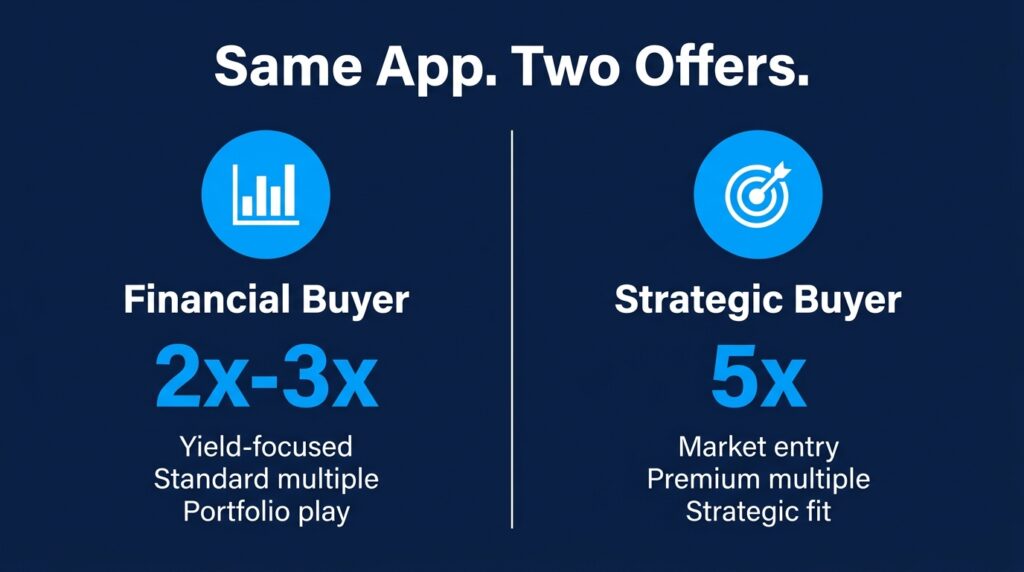
The first buyer in this deal was a financial operator. He ran a portfolio of apps and bought on yield. For him, $28k MRR was the asset. He ran his standard model, landed at 3x annual SDE, and that was the offer.
The second buyer was a SaaS company that had been trying to break into mobile for two years. They had the product. They had the team. What they did not have was a user base in the category. This app handed them that in one transaction.
For them, the $28k MRR was almost irrelevant. They were buying market entry. Their offer came in at 5x.
Same app. Same data room. A $180k gap in final offers. That gap is the app valuation multiple in action – and it tells you everything about who you are selling to.
Strategic Buyers vs. Financial Buyers: What Is Actually Driving the Market
This is not a one-off story. It reflects a broader shift in who is buying mobile apps right now.
Strategic acquirers made up over 62% of lower-middle-market software transactions in 2025, according to Axial’s deal activity data, up from 55% in 2023. Operating companies are treating mobile app acquisition as a growth engine, not just a yield play. They are buying user bases, category access, and defensible niches they cannot build fast enough on their own.
Financial buyers still operate on yield. A 2x to 3x annual SDE multiple is their anchor. They will optimize operations, maybe merge it with another asset in their portfolio, and hold for five to seven years.
Neither type is wrong. But they value your app for completely different reasons. And if you only pitch to one type, you are leaving real money behind.
What This Means When You Want to Sell My App
Most founders who decide it is time to sell my app start by asking what the app is worth. That is the wrong first question. The right one is: worth it to whom? Our guide on how to sell your app breaks down the full process.
The pitch comes after you understand what the buyer actually needs. Not what they say they want. What they are trying to solve.
A financial buyer wants predictability. Clean books, consistent MRR, low churn, simple operations. If your app fits that, your job is to prove the numbers hold up under scrutiny.
A strategic buyer wants fit. They are asking whether your user base overlaps with their target market, whether your tech integrates with their stack, whether buying you gets them somewhere faster than building from scratch. If your app fits that, the app valuation multiple conversation looks completely different.
The app valuation multiple you land is not just a function of your revenue. It reflects how much the right buyer wants what you have specifically built – and whether your deal process reached them at all.
At OEB Digital, we have closed over $20M in mobile app M&A deals, working with founders across 40+ countries. The deals that close at the top of the range almost always share one thing: the buyer and the asset were genuinely aligned before the first number was discussed.
The App Valuation Multiple Takeaway for Founders
If you are thinking about selling your app in the next 12 to 24 months, start here.
Write down the three most defensible things about what you have built. Not just the revenue. The user base, the category, the retention, the niche you own. Then ask yourself honestly: who would pay a premium to own those things?
A financial buyer is paying for yield. A strategic buyer is paying for access to something they cannot replicate quickly. Your job is to find the second type if your app qualifies.
Not every app has strategic buyer appeal. But the ones that do are almost always undervalued when they go through a process built for financial buyers only.
Common Questions About App Valuation Multiples
What is a typical app valuation multiple? Financial buyers typically pay 2x to 4x annual SDE for profitable apps with clean books and consistent revenue. Strategic buyers can push well past 5x when the app gives them market access, a user base, or a category position they cannot build on their own.
What drives a higher app valuation multiple in a mobile app acquisition? The biggest driver is buyer fit. An app sold to the right strategic buyer will almost always command a higher multiple than the same app sold through a process built for financial operators. Category, user base quality, retention, and the cost of building an alternative all factor in – but only if the right buyer is in the room.
How long does a mobile app acquisition typically take? Most off-market deals close in 60 to 120 days from first introduction to wire transfer. Deals with messy financials, unclear ownership, or misaligned seller expectations take longer. The cleaner your books and the clearer your terms, the faster it moves.
Ready to Understand What Your App Is Worth to the Right Buyer?
We work exclusively off-market. No public listings. No tire-kickers. Serious buyers only.
If you are building toward an exit and want to know how the right buyer would value your app, start here. OEB Digital has closed $20M+ in app and game deals across 40+ countries.
And if you are a buyer looking for apps in the $5k to $500k monthly net profit range, see what we have available.