A founder emailed us last year certain his app was worth $1.2 million. It made $30k a month. He had done the math himself: annual revenue times a multiple he read on a forum. The real offers landed near $520k. He felt insulted. He was also wrong about how mobile app valuation actually works.
Your app is not worth your revenue. Mobile app valuation is profit times a multiple, and the multiple is where most founders win or lose six figures. Get the inputs right and you walk into offers knowing your floor. Get them wrong and you either scare buyers off with a fantasy price or leave real money on the table.
What Mobile App Valuation Actually Measures
Buyers do not pay for revenue. They pay for profit they get to keep.
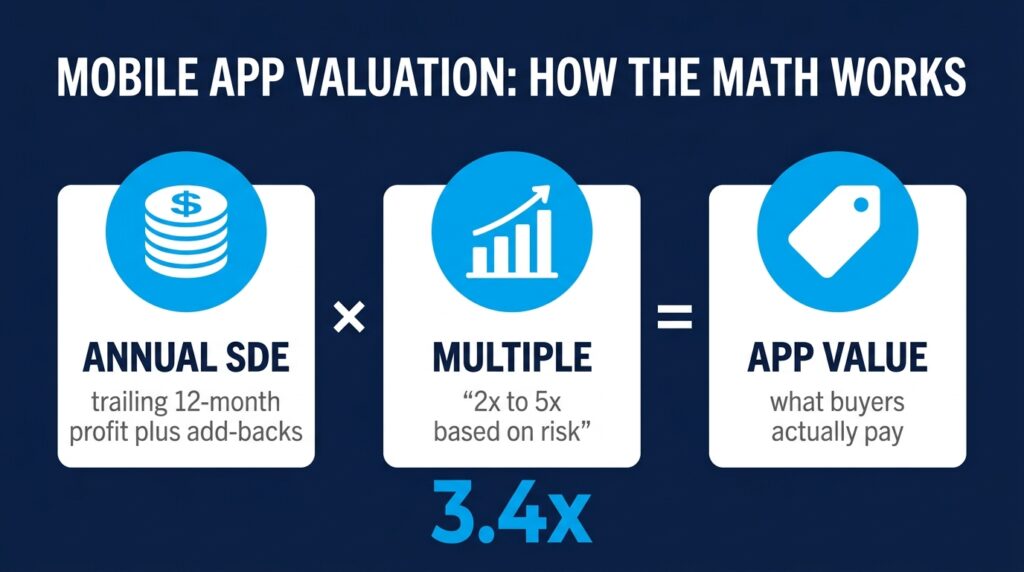
The number that matters is your SDE, or seller’s discretionary earnings. For most app deals that is the real profit left after the running costs a buyer inherits: servers, tools, ad spend, and the maintenance needed to keep the app live. A $30k-a-month app with $6k in server, ad, and tool costs has about $24k in monthly SDE, or roughly $288k a year.
That annual SDE is the base of every mobile app valuation. Everything after it is about the multiple you earn on top.
The Multiple Is Where the Money Is
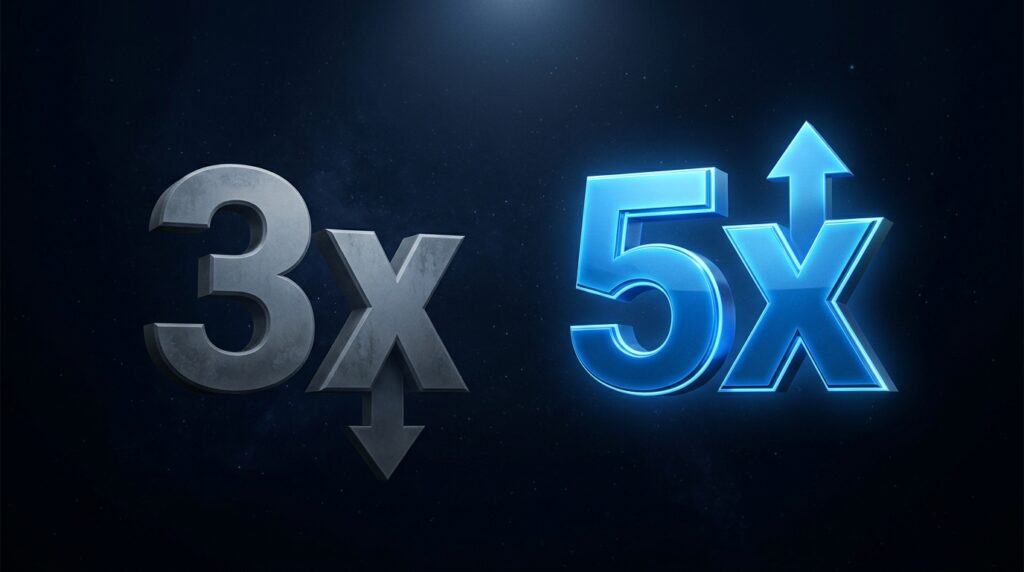
Most profitable apps sell between 2x and 5x annual SDE. Software and app businesses sold on BizBuySell carried an average earnings multiple of 3.4 in 2025. Where you fall in that range decides everything.
Same profit, different multiple, wildly different price. A $288k SDE app at 2.8x is worth about $806k. The same app at 4.2x is worth $1.21 million. That gap of over $400k has nothing to do with the revenue. It has to do with risk.
Two buyers can look at the identical P&L and price it $180k apart. We broke down exactly that in why two buyers offered $180k apart for the same app. The multiple is a measure of how confident a buyer is that your profit survives after you walk away.
How to Calculate Your Mobile App Valuation
Start with your trailing twelve months, not your best month. Add up net profit across the last 12 months. One viral month counts for little if the other eleven were flat.
Be careful with add-backs. In most app deals the app sells without you and without your developers, so a buyer still has to pay for that work. Your own salary and your development costs only get added back when the app is sold together with the team.
Pick an honest multiple. Start conservative, around 3x for a stable app, then move up or down based on the factors below.
Finally, sanity-check against revenue. Apps in the $500k to $2M annual revenue range often trade at 1.8x to 2.5x revenue as a cross-check. If your profit-based number comes out wildly higher than that, one of your inputs is off.
Here is that math on a real profile. Say your app cleared $21k, $22k, $20k, $24k, $23k, $25k, $22k, $26k, $24k, $27k, $25k, and $29k in net profit over the last twelve months, after the server, tool, and ad costs a buyer inherits. That is about $288k in SDE. At a conservative 3x, your starting number is roughly $864k. Prove clean 40% year-over-year growth and low churn and that same app pushes toward 4x, or about $1.15 million. Nothing about the app changed. Only the evidence did.
What Moves Your Multiple Up or Down
Retention is the single biggest lever. Every percentage point you cut from churn can add 10 to 20 percent to your multiple. Two founders can post the same MRR, but the one with strong Day-30 retention sells for far more than the one bleeding users. That is the whole story behind the retention trap that cost one founder $750k.
Revenue concentration hurts you. If 70% of your income runs through one ad network or one traffic source, buyers price in the risk that it vanishes overnight.
Key person risk hurts more. If the app runs on your relationships and your undocumented decisions, a buyer is purchasing a job, not an asset. Documented operations pull your multiple up.
Growth direction sets the ceiling. An app growing 40% year over year earns a premium. A declining one gets discounted no matter how good last month looked.
The market itself is strong. Consumer spending on apps hit roughly $156 billion in 2025, and apps outspent games for the first time. Buyers have money. What they are pricing is your risk, not the size of the market.
Common App Valuation Questions
How long does it take to value an app?
A rough number takes an afternoon once you have 12 months of clean P&L data. A real valuation takes longer, because we look past the profit at your retention, the geography of your users, your DAU and MAU, your margins, and how your marketing performs. Those inputs are what separate a hopeful figure from a number a buyer will actually pay.
Should I value my app on revenue or profit?
Profit. Revenue multiples are a cross-check, not the headline number. Two apps with identical revenue can carry very different profit, and buyers pay for what they actually keep.
What counts as a good multiple?
Most healthy, profitable apps land between 3x and 5x SDE. Below 3x usually signals concentration risk, weak retention, or heavy founder dependence. Above 5x means you have proven durable growth and clean, transferable operations.
How much do mobile apps sell for?
Most mobile apps and games sell for 2x to 5x annual net profit. An app clearing $10,000 a month in profit is worth roughly $240,000 to $600,000 depending on where it lands in that band. Where you land is decided by revenue stability, retention, and how much of the business walks out the door with you.
How much is an app with 100,000 users worth?
On its own, nothing. Buyers do not pay for installs or registered users. They pay for profit that keeps arriving after the handover. An app with 100,000 users and no revenue is an audience, and audiences sell for very little. The same app monetizing at $8,000 a month in profit is a real asset with a real multiple.
How is an app valuation multiple calculated?
Start with trailing twelve month net profit, then apply a multiple that prices risk. Subscription revenue with proven retention earns the top of the band. Revenue concentrated in one ad network, one geography, or one viral spike earns the bottom. The multiple is a measure of how confident a buyer is that your numbers survive without you.
Does an app with no revenue have any value?
Sometimes, but it is priced as a technology or user acquisition purchase, not a profit multiple. Expect a fraction of what a monetized app earns. If you are within twelve months of wanting to exit, turning on monetization and building a revenue history is worth more than any feature you could ship.
So What Is Your App Actually Worth?
Take your trailing twelve-month SDE, multiply by 3x as a starting point, then move up or down for retention, revenue concentration, key person risk, and growth. That gives you a defensible range instead of a fantasy number.
When a real offer lands, you will know whether it is fair or low, and you will negotiate from data instead of ego. Your mobile app valuation is only as strong as the numbers behind it.
Do not anchor on the biggest number a competitor claims to have gotten. Anchor on your own trailing profit and the quality of the proof behind it. Clean books, documented operations, and steady retention are what turn a hopeful figure into a price a serious buyer will pay.
When you do sell, run the money through a licensed escrow service so funds stay protected until the assets transfer. And if you want a real number on your specific app before you list, that is exactly what we do. See what your app could sell for.