A founder emailed us last year with a simple question: how to sell a mobile app that was making $22k a month. He had already listed it on a public marketplace for six weeks. Two offers came in, both under 2x annual profit, and both buyers went quiet during due diligence.
He was not doing anything wrong. He just did not have a process. Selling a mobile app is not one decision. It is a sequence of them, and the order matters more than most founders think.
This guide walks through how to sell a mobile app the way deals actually close, from pricing to the final wire.
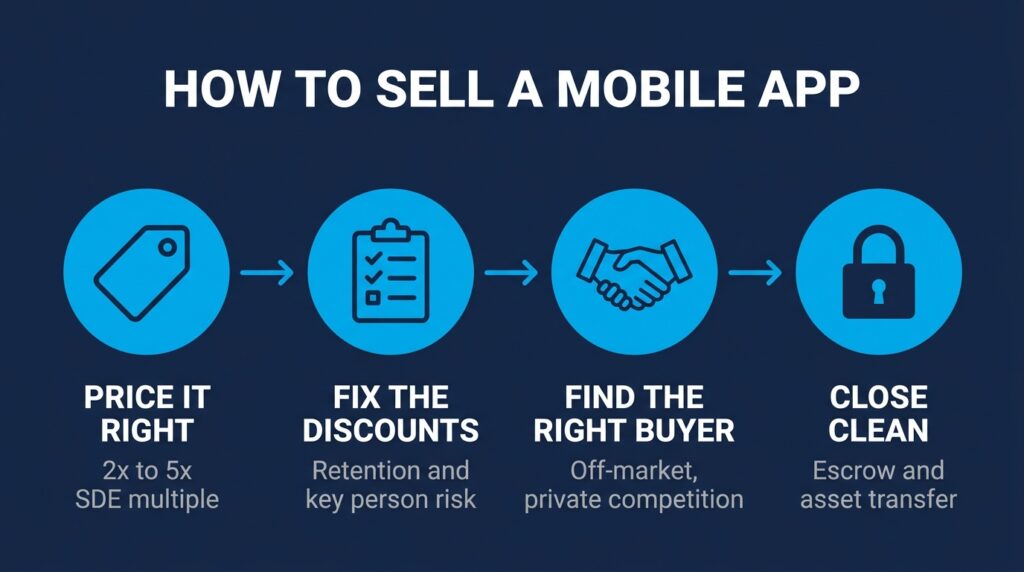
How to Sell a Mobile App: The Four Steps That Matter
Every clean app exit follows the same four steps. Price the app correctly. Fix the things buyers use to discount you. Get in front of the right buyer. Then survive due diligence and close without losing the deal.
Skip a step and you feel it in the final number. Do all four in order and you protect every dollar you built.
Step 1: Price Your App Before You Fall in Love With a Number
Most founders start with the wrong question. They ask what they want for the app instead of what a buyer will actually pay.
App valuation comes down to two things: your profit and your multiple. Mobile apps generally sell for 2x to 5x annual profit, measured as seller’s discretionary earnings, or SDE. SDE is your net profit with the owner salary and one-off costs added back.
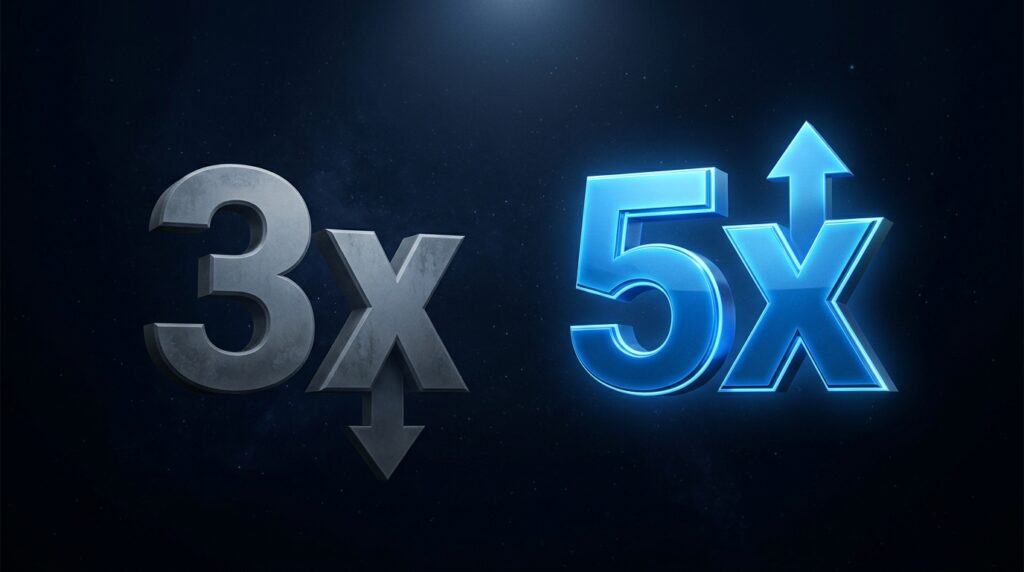
The multiple is where the money hides. A $20k MRR app at 3x is worth about $180k less over a year than the same app at 5x. What moves it up? Strong retention, a diversified revenue mix, and an app that does not depend on you.
We broke down how app valuation multiples change based on the buyer in a real deal where two offers came in $180k apart on the same app.
Step 2: Fix the Things Buyers Use to Discount You
Before you list, look at your app the way a buyer will. They are not buying your vision. They are buying cash flow they can keep after you walk away.
The fastest way to lose money is weak retention. One founder had $30k MRR and 3% Day-30 retention, and it cost him $750k on the sale. Buyers price churn, not hype.
The second killer is key person risk. If the app only runs because you run it, that is a discount. Document your ASO, your ad accounts, your update process, and your vendor logins before anyone asks.
Our full checklist for preparing your app for sale covers what to clean up in the 90 days before you list.
Step 3: Sell Off-Market to the Right Buyer
Here is where how to sell a mobile app splits into two very different paths.
Public marketplaces give you traffic. You get a listing, a flood of tire-kickers, and offers pushed down because everyone is looking at the same asset at the same time.
Off-market is the opposite. You go to a short list of real buyers who compete privately, which creates bidding pressure without putting your app on display.
The buyer type matters as much as the price. A strategic buyer who can plug your users into an existing portfolio will often pay more than a financial buyer pricing pure cash flow. Knowing which buyer is which is how you sell to the highest bidder instead of the loudest one.
Step 4: Survive Due Diligence and Close Clean
Once you accept an offer and sign a letter of intent, due diligence starts. For most small app deals this runs 30 to 90 days.
The buyer will verify revenue, retention, and ownership of every asset. Have your P&L, store analytics, and payment processor exports ready. A clean data room closes deals. A messy one loses them.
Money should never move directly between two strangers. Use an escrow service so funds release only after the app store transfer and asset handover are complete.
A prepared seller can move from signed offer to closed deal in a few weeks. A disorganized one can stretch the same deal into months, and every extra week is a chance for the buyer to renegotiate.
Read the asset purchase agreement line by line. Watch for earn-outs, long transition periods, and holdbacks that move risk onto you after closing. The headline price is not the deal. The terms are.
Frequently Asked Questions
How much is my app worth?
Take your annual profit and apply a multiple, usually between 2x and 5x. A $22k per month app netting $200k a year lands somewhere between $400k and $1M, depending on retention, growth, and how transferable it is. If you want the full method, our mobile app valuation guide walks through the math.
Do I need a broker to sell my app?
Not always, but the gap shows up in the final number and in deals that survive due diligence. A broker runs a private process, creates competition between buyers, and keeps emotion out of the negotiation.
How long does it take to sell a mobile app?
For a prepared seller, four to eight weeks from listing to close is realistic. Weak documentation or a single unresolved issue can double that.
The Bottom Line
Knowing how to sell a mobile app is really about controlling the order: price it right, fix the discounts, find the right buyer, and close clean. Skip a step and you leave money on the table.
If your app or game earns $5k a month or more and you want to see what a private, off-market process looks like, tell us about your app and we will show you where the value is.