Two founders came to us in the same month with nearly identical numbers. Both ran subscription apps clearing about $18k a month in profit. One got offers at 3.1x. The other closed at 4.9x.
The app was not the difference. What each founder could prove was the difference. To increase app valuation multiple offers, you do not build a better product. You remove the reasons a buyer marks you down.
There are four of them. All four are fixable, and none of them can be fixed in the two weeks before you list.
Why the Same Profit Gets Two Different Offers
Buyers do not pay for your revenue. They pay for the odds that your revenue still shows up after you hand over the keys.
That is why apps trade in a band instead of at a fixed number. Most deals we close land between 2x and 5x SDE. One subscription app we sold closed at 4.2x while the market was paying 2.8x, and the gap came down to eight months of retention work done before it was listed. The spread inside that band is almost entirely a risk story, not a quality story.
A buyer’s first real question is blunt: what happens to this app if paid acquisition goes to zero for six months? If the honest answer is that revenue holds, you are near the top of the band. If the answer is that nobody knows, you are near the bottom. Every lever below points back to that one question, because everything that will increase app valuation multiple offers is really about answering it with evidence.
Their caution is earned. Average day 30 retention sits at 5.3% on iOS and 3.8% on Android, so most apps really do decay fast. Your job is to prove you are not most apps.
Lever 1: How to Increase App Valuation Multiple Offers With Retention Data
Founders describe retention. Buyers want it exported.
There is a wide gap between “our users stick around” and a cohort chart showing 14 months of renewals broken out by acquisition source. The first gets you a 3x conversation. The second gets you a 5x one.
Subscription apps show this most clearly. Just over 25% of annual subscribers are still active after a year, against 7.6% of monthly subscribers, according to RevenueCat’s 2026 report across 115,000 apps. If your mix skews annual and you can show it in the data, that is worth real multiple points.
One founder lost $750k because his retention story fell apart under diligence. The numbers were fine. The proof was not. We broke down exactly what went wrong in how app retention metrics cost one founder $750k.
Time to fix: 3 to 6 months. You cannot backfill cohort data you never collected, which is why this lever goes first.
Lever 2: Stop Letting One Thing Carry the Revenue
Concentration is the quietest discount in app M&A.
One acquisition channel. One country. One price point. One store ranking that has held for eight months and nobody can say exactly why. Each one hands a buyer a reason to model a downside case, and downside cases come straight out of your multiple.
Pricing is where founders see movement fastest. High priced apps generate $34.82 in monthly realized lifetime value per payer against $10.69 for low priced apps. Testing a higher tier does two jobs at once. It lifts revenue, and it proves your users are not only there because you are cheap.
Time to fix: 6 to 9 months. Channel diversification is slow work. Pricing tests are not.
Lever 3: Be Diligence Ready Before You List
Documentation does not raise your multiple. Missing documentation lowers it.
Financial diligence routinely moves valuations by 15% to 25%, and almost none of that movement goes the seller’s way when numbers arrive late or reconstructed from memory.
Here is what a serious buyer expects to see in week one:
- Monthly P&L for the last 24 months
- Store payout statements that reconcile to that P&L
- Ad spend broken out by channel
- An honest list of what you personally do each week
- Contracts for anything you outsource
Funds sit in escrow while all of this gets verified, so every week of missing paperwork is a week your money sits still. Our guide on preparing your app for sale covers the full list.
Time to fix: 30 to 60 days. This is the cheapest lever on the page and the one most founders skip.
Lever 4: Sell Into Your Trend, Not Your Calendar
Timing is a valuation input, not a scheduling detail.
Median year over year MRR growth for subscription apps is 5.3%, while the top 10% grew 306%. A buyer reading your last six months is deciding which of those two stories you belong to.
Flat and stable prices lower than modest and climbing. Declining prices lower still, no matter how strong the trailing twelve months look on paper. Founders who get 5x are usually selling while the chart still points up, which feels early and is not.
Two buyers once came in $180k apart on the same app, largely because they read that trend differently. We walked through both offers in why two buyers offered $180k apart for the same app.
Nothing will increase app valuation multiple offers faster than selling six months early instead of six months late.
Time to fix: this one is not a fix. It is a decision, and it expires.
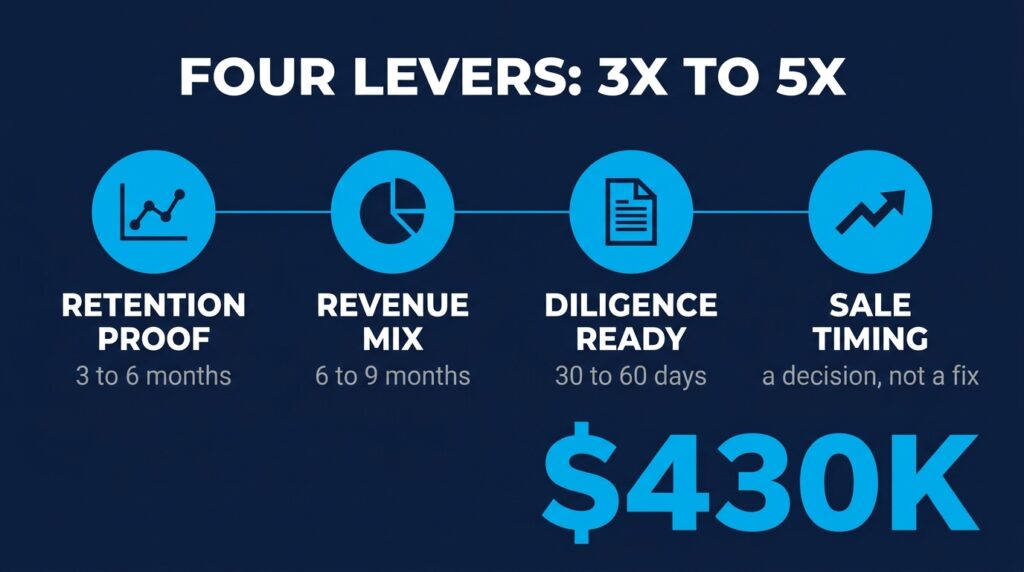
None of these four levers asks you to build anything new.
Retention you can export. Revenue that does not lean on one thing. Paperwork ready before the first call. A trend line pointing the right way. For most apps, that is the entire distance between a 3x and a 5x.
On $18k a month in profit, that gap is roughly $430k. Six to twelve months of preparation is a fair price for it.
If you are thinking about an exit inside the next year, start while all four levers are still in play. That is the whole game when you want to increase app valuation multiple offers instead of accepting the first one. Talk to us about selling your app and we will tell you which lever is costing you the most right now.