A founder decided to sell an app without a broker to save the commission. Eight weeks later, the deal that should have closed at $700k closed at $450k, and the buyer told him exactly why.
This is for founders who already have a live, revenue-generating app and are weighing whether to run the sale process themselves. If you are still pre-revenue or pre-launch, the math below does not apply to you yet.
The app in question was a subscription utility doing about $28k a month in net profit, the kind of asset that typically trades at a 2x to 5x SDE multiple depending on retention and growth. At a fair multiple, $700k was a realistic number going in.
The founder was not wrong about the value. He was wrong about how much the sale process itself would cost him.
Plenty of founders sell an app without a broker and it works out fine. This one did not, and the reason was time, not ego.
The Real Timeline When You Sell an App Without a Broker
He listed the app on a general marketplace in week one. It took three weeks before a serious buyer showed up, and by week five he was answering due diligence questions himself, at night, after running the app all day.
That is the part most founders underestimate. A real sale means building a financial package, pulling App Store and analytics data, recording screen walkthroughs, and taking buyer calls on top of a full-time job. Every one of those hours comes out of the same week you are supposed to be running the business.
What Delayed Due Diligence Actually Costs You
Revenue dipped 12% over the eight-week process. Not because the app broke. Marketing slowed, a planned update shipped two weeks late, and a backlog of support tickets started to show up in the app’s ratings.
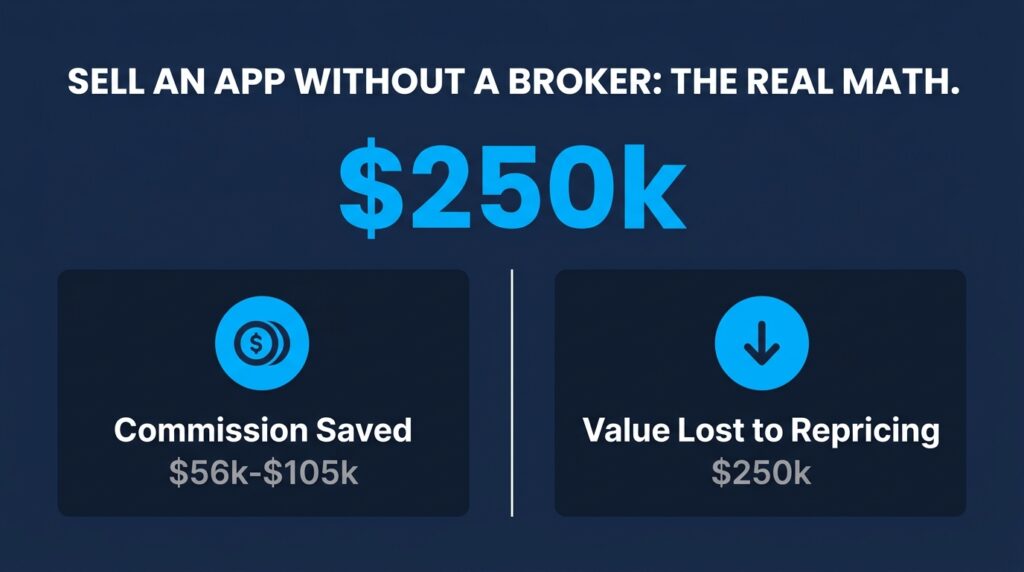
The buyer noticed. Before signing, he asked for a fresh trailing 30-day P&L, saw the dip, and cut his offer by $250k on the spot.
He was not being difficult. Industry research puts business sale failure rates at 70 to 80 percent for privately held businesses that go to market, and a buyer who has seen that many deals collapse treats a downward trend as a reason to walk, not negotiate softly.
Why the Buyer Cared More About the Trend Than the Story
A founder selling solo has one story to tell: “the dip is temporary.” A managed sale process backs that story with a locked diligence timeline, buyer vetting that happens before financials are shared, and a seller who is not also the one answering support tickets at midnight. Our own breakdown of what to expect when selling your app walks through why that sequencing protects your number more than any pitch does.
That is the real tradeoff whenever someone decides to sell an app without a broker: less oversight on the timeline, and less room to absorb a bad week.
When the deal did close, it closed slower than it needed to. There was no structured escrow process lined up in advance, so the founder was negotiating payment terms and an escrow service in the same week he was supposed to be finalizing the asset transfer. A service like escrow.com exists specifically to keep that step from becoming a second negotiation.
What a Broker Actually Changes About This Math
A broker does not just find the buyer. A broker screens buyers and gates NDAs before your P&L goes anywhere, keeps the diligence clock on a schedule instead of a buyer’s whim, and takes the day-to-day founder-to-buyer messaging off your plate so your metrics stay flat through the process instead of drifting.
That is the actual trade you are making when you decide to sell an app without a broker. You keep the commission. You take on the deal management, the buyer screening, and the risk that a slow process shows up in your own numbers before the ink is dry. Our piece on why founders use a broker for their mobile exit breaks down where that commission actually goes. Whichever route you take, the steps are the same, and we lay them out in how to sell your app and nail your exit.
Founders who sell an app without a broker are not doing anything wrong. They are just carrying risk that a managed process is built to absorb.
The Math Founders Get Wrong
Run the numbers side by side. Saving an 8 to 15 percent commission on a $700k deal is $56k to $105k back in your pocket. Losing $250k to a re-priced offer because your trailing metrics dipped mid-process wipes that saving out more than three times over.
The commission is the cost you can see up front, which is exactly why it feels like the bigger number. The revenue drift is the cost you only see in week seven, after the buyer has already asked for updated financials.
This is the real math behind the decision to sell an app without a broker: it only pencils out if the sale takes exactly as long as planned.
A managed, off-market process is built to close in weeks once a qualified buyer is under an LOI, not months of open-ended back and forth with a long list of unqualified tire kickers. Shorter, better-paced timelines are exactly why founders who go the managed route tend to protect their number instead of watching it slide over the life of a long, solo listing.
Frequently Asked Questions
Can I sell an app without a broker?
Yes, and plenty of founders do it. The tradeoff is time and risk: you take on buyer vetting, deal management, and diligence pacing yourself, and any slowdown in that process tends to show up as a revenue dip that gives the buyer room to reprice you.
How much do app brokers charge?
Most app brokers charge a commission in the 8 to 15 percent range, similar to business brokers in other industries, and typically only get paid when the deal closes. On a $700k deal, that is $56k to $105k, which is the number founders compare against when they consider whether to sell an app without a broker.
What is the biggest risk of selling an app on your own?
The biggest risk is revenue drift during the sale itself. Diligence and buyer calls take real hours, those hours come out of running the app, and a buyer who sees softening metrics mid-process almost always uses it to cut the offer, not just ask a question.
The commission you save by choosing to sell an app without a broker only pays off if nothing slips during the process. For most founders running the app solo while also selling it, something slips. If you want a second opinion on what your app is actually worth and what a managed process looks like, start here: sell your app with OEB.