You own a live app that earns real profit, and you want one number: how much can you sell an app for? Most founders guess off revenue, and the guess is wrong before the first buyer call.
This guide is for sellers who already own a profitable app, not for anyone building one. Below is the math buyers use, the five factors that move your price, and a worked example at $10k a month.
How Much Can You Sell an App For? The Short Answer
Most apps sell for 12x to 36x their monthly profit, according to RevenueCat’s guide to selling a mobile app. That works out to roughly 1x to 3x annual profit for a typical listing.
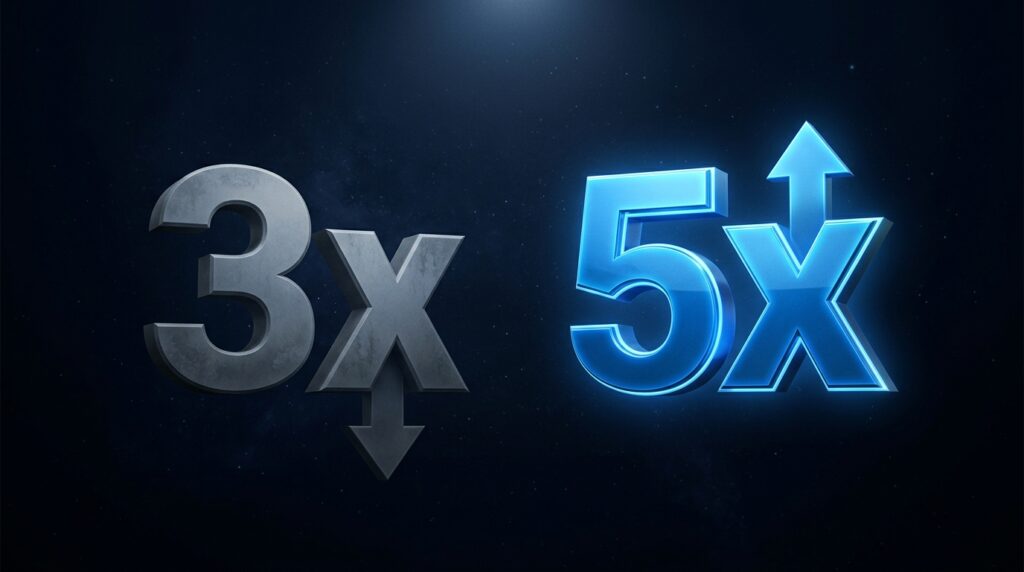
Well-run apps with clean books and steady retention sit higher. In OEB deals the range is 2x to 5x annual SDE, which is seller’s discretionary earnings: net profit plus your own pay and any one-off costs. The gap between 2x and 5x on the same app is where most of the money is made or lost.
OEB has closed $20M+ in app and game deals across 40+ countries, mostly apps earning $5K to $500K a month. On every one of them, profit set the price, not revenue.
The Math: Profit Times a Multiple
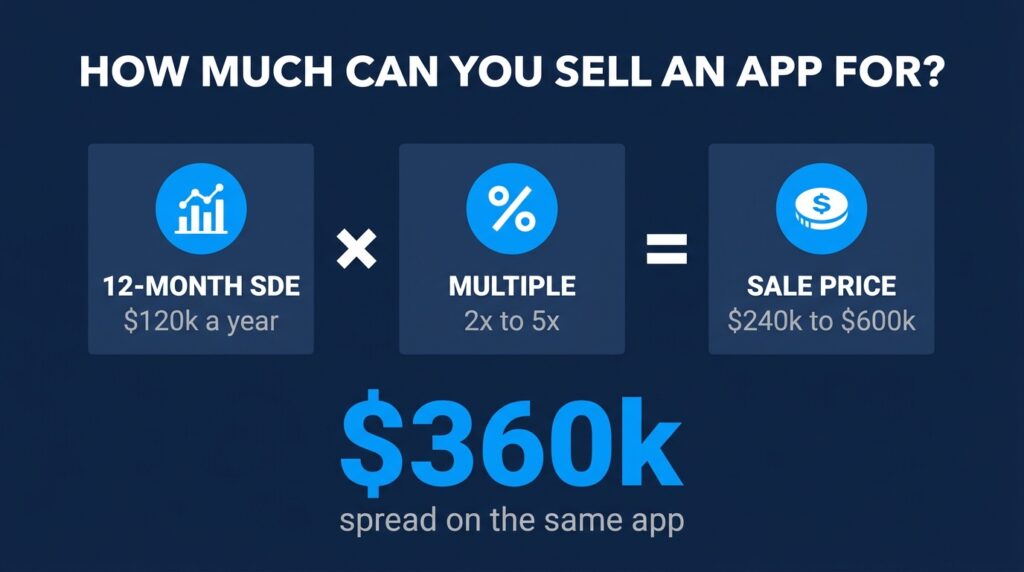
Start with 12 months of net profit after store fees, ad spend, contractors, and server costs. Add back what you pay yourself and anything that will not repeat. That number is your SDE.
Now apply the multiple. A $10k a month app earns $120k a year in SDE. At 2x that is $240k, at 3x it is $360k, and at 5x it is $600k.
Same app, same profit, a $360k spread. That is why two buyers can offer $180k apart for the same app. The honest answer to how much can you sell an app for is always a range, never a single figure.
5 Things That Move Your App Price Up or Down
Revenue model. Subscription apps with low churn command much higher valuations than apps that depend on one-time purchases or ad revenue. One subscription app reached 4.2x on that strength, and you can see how in this 4.2x subscription exit.
Retention. Buyers underwrite how long users stay. Day-30 retention that holds flat across cohorts is worth more than a big install number, and weak retention can cost real money, as one founder’s $750k retention mistake shows.
Owner dependence. If you are the product, a buyer prices in the risk of you leaving. Documented processes and a clean handover plan lift your multiple.
Clean books. A P&L that ties to your store console exports holds its price through diligence. Messy numbers give a buyer a reason to retrade you.
Growth direction. Fluctuating downloads or revenue push the price down, while a flat or rising 12-month trend earns a higher multiple at the same profit today. If you want the full playbook, read how to increase your app valuation multiple.
Buyers also look at concentration. If one traffic source, one ad network, or one store account drives most of your profit, expect a lower multiple, because a single policy change can erase the income.
Platform and revenue mix matter too. An app earning across iOS and Android, with more than one revenue line, reads as safer than a single-channel app at identical profit.
What Can You Sell a $10k/Month App For? Three Scenarios
Take the same $120k SDE app and change one thing at a time. These figures are illustrations, not guarantees.
A declining, ad-supported app with the founder doing everything lands near 2x, about $240k. Stable revenue, documented code, and a clean P&L lands around 3x to 3.5x, roughly $360k to $420k.
A growing subscription app with flat cohort retention and a ready handover can reach 4x to 5x, or $480k to $600k. So how much can you sell an app for at the same profit? Anywhere from $240k to $600k, depending on how buyers read the risk.
Price is also not always cash at close. Earnouts and holdbacks can shift part of it, as in how deal structure added $40k to a $700k app sale.
Notice what did not change across those three cases: revenue. All three apps could bill the same amount each month. Only the quality of the profit changed, and that alone moved the price by $360k.
What to Do Before You Ask for a Number
Pull 12 months of store console exports and match them to your P&L line by line. Fix the gaps now, not during diligence.
Run the math at 2x, 3x, and 5x so you know your range before a buyer anchors you. Our mobile app valuation guide walks through the SDE calculation step by step.
Then set your floor. A realistic walk-away number decided before the first call stops a low opener from shaping the whole deal.
Gather your assets early: store accounts, source code, analytics access, third-party agreements, and contractor IP assignments. Buyers will ask for all of it, and a complete pack signals a founder who runs a tight business.
Finally, decide whether you want all cash at close or are open to structure. Flexibility on terms can raise the headline number.
Frequently Asked Questions
How much can you sell an app for with no profit?
You can still sell it, but the price shifts from profit to strategic value. RevenueCat notes that strategically valuable apps can sell for multiples of gross revenue even when they are not profitable, though that is the exception.
Do buyers price an app on revenue or profit?
Profit. Buyers apply the multiple to SDE, not gross revenue, because revenue ignores fees, ad spend, and costs. Two apps with the same monthly revenue can differ by hundreds of thousands of dollars in value.
How long does it take to sell an app?
It depends on deal size and diligence depth. One brokered $2.1M OEB deal closed in eight weeks, and smaller deals can move faster. Read what to expect when selling your app for the full timeline.
If you are still asking how much can you sell an app for, start with a real number. Talk to OEB about selling your app and get a data-backed valuation before you ever list.